An expert, evidence-based guide from the Kenyan savanna
Among Kenya’s Big Five, danger is often incorrectly associated with predators. In reality, the animal responsible for the greatest risk to humans, predators, and even professional guides is not the lion or leopard—it is the African Buffalo.
This guide explains why buffalo are widely regarded by wildlife professionals as the most dangerous Big Five animal, drawing on ecology, behavior, and real-world field experience from Kenya.
1. “Dangerous” Means Unpredictable—Not Carnivorous
Danger in wildlife biology is not defined by diet. It is defined by:
- Willingness to attack
- Ability to injure or kill
- Likelihood of standing ground
- Lack of warning signals
By these measures, buffalo outperform every other Big Five species.
Unlike predators, buffalo:
- Do not need to hunt
- Do not retreat reliably
- Do not bluff often
They decide, then act.
2. The Buffalo Temperament: Defensive, Decisive, and Relentless
Buffalo are highly intelligent herd animals with strong threat perception.
Key behavioral traits
- Exceptional memory (especially of threats)
- Rapid group response
- Immediate escalation rather than avoidance
- Willingness to pursue perceived danger
A buffalo does not rely on intimidation displays.
It relies on impact.
This is why many seasoned Kenyan guides say:
“A lion may stalk you.
A buffalo may charge you.”
3. Physical Power: Built Like a Living Tank
Size and strength
- Adult weight: 500–900 kg
- Dense bone structure
- Extremely thick skin around neck and shoulders
- Horns capable of penetrating vehicles and crushing skulls
The horn boss
Adult males develop a fused horn boss, acting as:
- A battering ram
- A shield
- A weapon during combat
Even lions avoid frontal contact with a healthy adult buffalo.
4. Herd Defense: Collective Violence, Not Panic

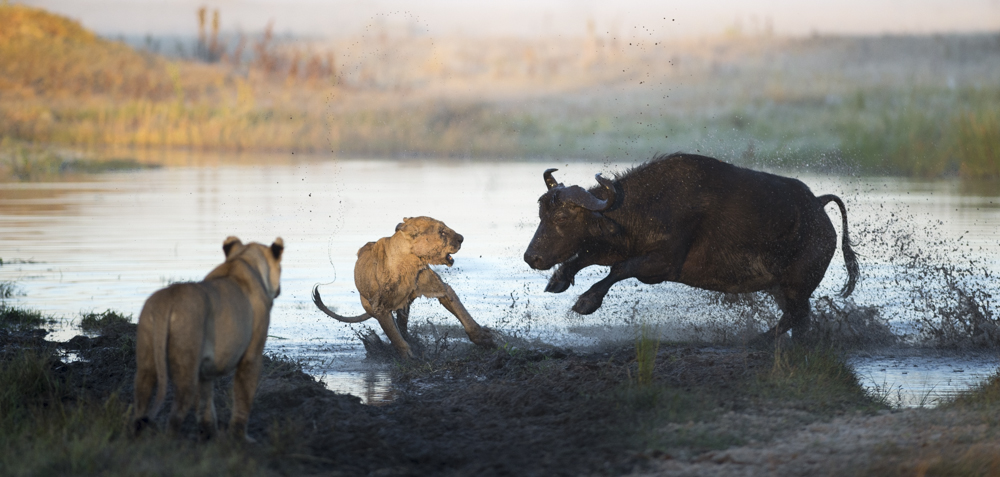
Most prey species flee.
Buffalo organize.
Herd defense strategies
- Form protective walls around calves
- Actively surround predators
- Launch coordinated counter-attacks
- Return to rescue captured individuals
In Kenya’s Masai Mara National Reserve, buffalo herds have been documented:
- Trampling lions
- Killing pride members
- Driving predators out of territories
This is not instinctive panic—it is learned, collective aggression.
5. The “Dagga Boy” Problem: Why Solitary Bulls Are the Worst
Older male buffalo often leave herds and become solitary or form small bachelor groups.
Known as dagga boys, they are:
- Physically past breeding prime
- Highly aggressive
- Easily provoked
- Less predictable than herd animals
Dagga boys account for:
- Most dangerous encounters with humans
- Many fatal lion injuries
- A disproportionate share of attacks on vehicles on foot safaris
They have nothing to lose—and they know it.
6. Buffalo vs Other Big Five Animals
| Big Five Species | Typical Response to Threat |
|---|---|
| Lion | Assess → stalk → avoid injury |
| Leopard | Flee or retreat to cover |
| Elephant | Bluff charge → escalate if needed |
| Rhino | Charge if surprised |
| Buffalo | Immediate attack, often without warning |
Buffalo are the least likely to disengage once committed.
7. Why Buffalo Kill More Lions Than Any Other Prey
Buffalo are:
- The most dangerous prey lions hunt
- Responsible for more lion deaths than any other herbivore
Lions must:
- Hunt in large prides
- Target calves or weak individuals
- Avoid frontal attacks
Even then, hunts often end in:
- Severe lion injuries
- Permanent disability
- Death
A buffalo does not need to win the fight—it only needs to injure.
8. Buffalo and Humans: A Serious Risk on Foot
Most historical buffalo attacks on humans occurred:
- During walking safaris
- With wounded animals
- Near dense cover
- When visibility was low
Buffalo:
- May ambush from cover
- May circle back silently
- May charge without vocalization
This is why professional guides rank buffalo as the most dangerous animal to encounter on foot in Africa.
9. Why Buffalo Are Often Underestimated
Buffalo lack:
- Dramatic hunting scenes
- Stealth or speed
- Iconic facial expressions
They appear slow.
They are not.
Buffalo combine:
- Strength
- Memory
- Coordination
- Willingness to fight
This makes them far more dangerous than they look.
10. The Ecological Reason Buffalo Matter So Much
Buffalo shape ecosystems by:
- Maintaining grassland structure
- Supporting large lion prides
- Driving predator cooperation
- Influencing herbivore distribution
Where buffalo disappear:
- Lion social systems weaken
- Ecosystems simplify
- Predator dynamics collapse
Danger, in this case, equals ecological power.
The Expert Verdict
Why are buffalo the most dangerous Big Five animal?
Because they:
- Do not flee reliably
- Do not bluff often
- Do not forgive mistakes
- Do not stop once committed
Lions are feared.
Elephants are respected.
Buffalo are avoided.
Among Kenya’s wildlife professionals, there is no debate.