A comprehensive, ecology- and conservation-focused guide to one of Kenya’s most formidable and misunderstood mammals
The African buffalo is one of the Big Five, yet it is often the least understood. In Kenya, buffalo are not just large bovids filling the background of a safari scene—they are keystone grazers, disease reservoirs, prey for apex predators, and one of the most dangerous wild animals on the continent.
1. Species, Taxonomy, and Conservation Status
African Buffalo
- Family: Bovidae
- Subspecies in Kenya: Cape buffalo (Syncerus caffer caffer)
- IUCN Red List status: Near Threatened (NT)
Kenya supports one of East Africa’s most important Cape buffalo populations, particularly within large savanna ecosystems.
Despite their abundance in some parks, buffalo are listed as Near Threatened due to habitat loss, disease, and fragmentation across their range.
2. How to Identify an African Buffalo
African buffalo are unmistakable once you know what to look for:
- Massive, dark brown to black body
- Stocky build with a low center of gravity
- Wide head with heavy horn bases
- Short, powerful legs
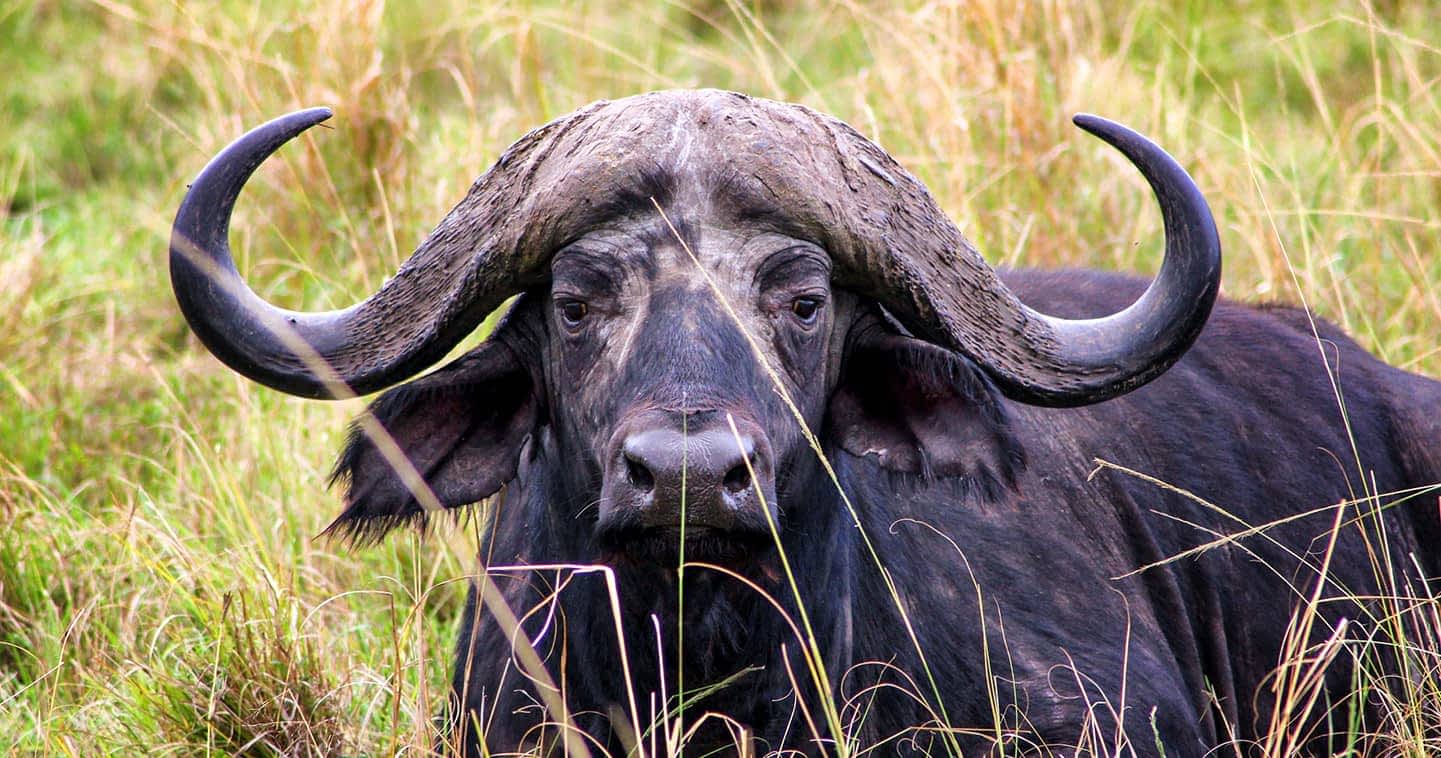
Horns: the defining feature
- Adult males develop a horn “boss”—a thick, fused shield across the forehead
- Horns curve outward and upward
- Females have narrower, less fused horns
The horn boss is often used by guides to age and sex buffalo in the field.
3. Buffalo Ecology and Behavior
Grazing strategy
Buffalo are bulk grazers, feeding primarily on:
- Medium to tall grasses
- Floodplain and wetland vegetation
Unlike selective grazers (e.g. wildebeest), buffalo can exploit coarser grasses, allowing them to persist through dry seasons.
Daily activity
- Graze mostly early morning and late afternoon
- Rest and ruminate during midday heat
- Depend heavily on daily access to water
This makes water availability a key factor in buffalo distribution.
4. Social Structure: Herds, Bulls, and “Dagga Boys”
Buffalo society is complex and fluid.
Herd structure
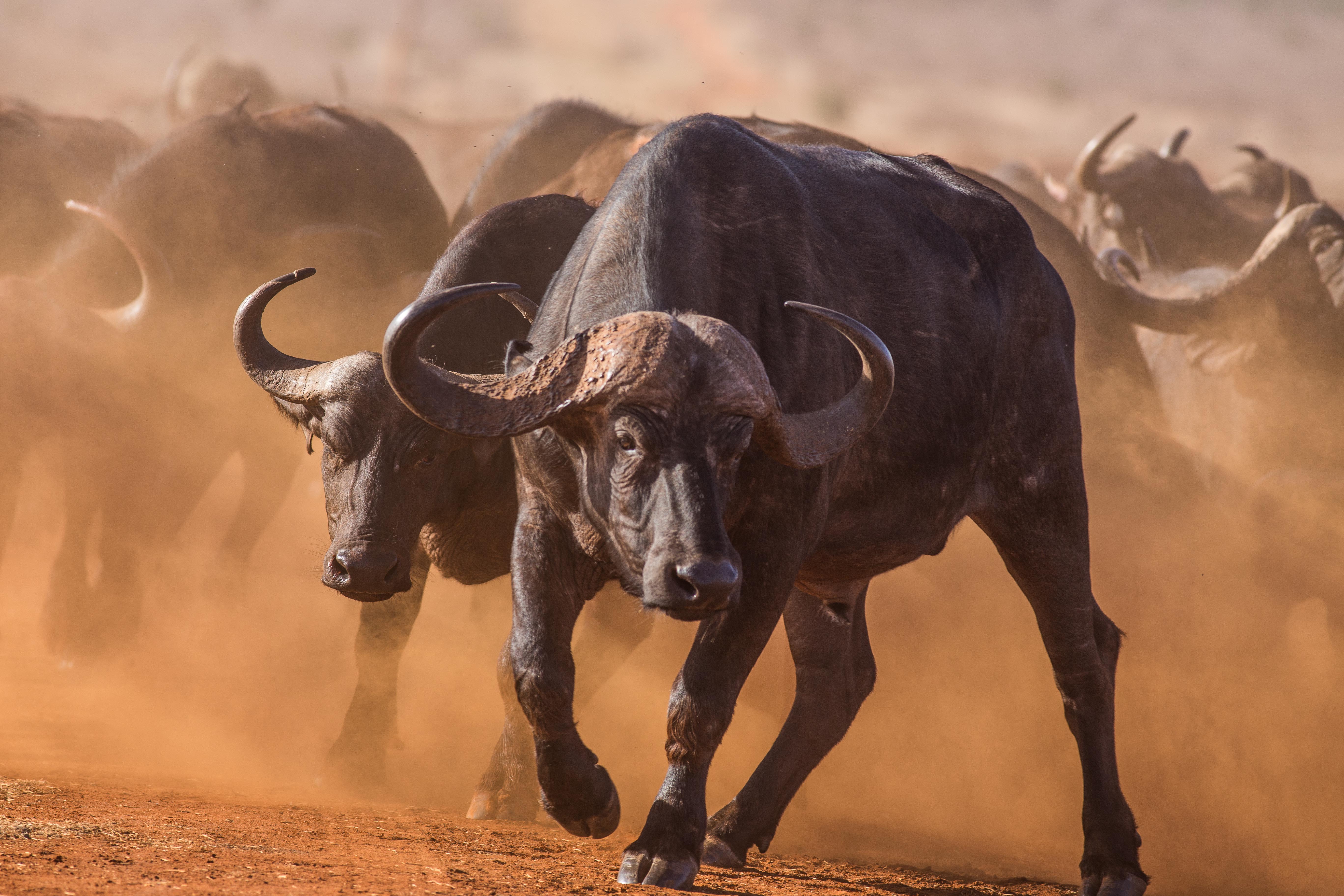
- Large mixed herds of 50–500+ individuals
- Core composed of adult females and calves
- Bulls may remain or drift between herds
Bachelor bulls (“Dagga Boys”)
Older males often leave herds to form small groups or live alone.
- Spend time wallowing in mud (“dagga”)
- Frequently aggressive and unpredictable
- Responsible for most dangerous encounters
These solitary bulls are the source of the buffalo’s fearsome reputation.
5. Why Buffalo Are Considered Dangerous
Buffalo are widely regarded as the most dangerous of the Big Five.
Key reasons
- Highly defensive and aggressive when threatened
- Strong herd defense of calves
- Excellent memory—may ambush perceived threats
- Capable of killing lions and humans
Most incidents occur:
- On foot (historically during hunting)
- With wounded or cornered animals
- Near solitary bulls or calves
In safari vehicles, buffalo are safe to observe when proper distance is maintained.
6. Buffalo in Kenya’s Ecosystems
Buffalo play several critical ecological roles:
- Maintain grassland structure through heavy grazing
- Create grazing opportunities for smaller herbivores
- Serve as primary prey for lions
- Influence predator movements and pride behavior
In ecosystems like the Masai Mara National Reserve, buffalo availability directly affects lion pride size and success.
7. Where Buffalo Are Found in Kenya

5
Buffalo are widespread but strongly tied to water and productive grasslands.
Key buffalo strongholds
- Masai Mara National Reserve – Large herds year-round
- Amboseli National Park – Dense herds in swamp systems
- Tsavo East National Park & Tsavo West National Park – One of Kenya’s largest populations
- Lake Nakuru National Park
- Nairobi National Park – Surprisingly strong urban-edge population
Buffalo are largely absent from very arid northern Kenya, where water is unreliable.
8. Buffalo and Predators: A Constant Arms Race
Buffalo are among the most dangerous prey animals for lions.
- Lions prefer buffalo calves or weak adults
- Hunts often require large, coordinated prides
- Buffalo regularly counter-attack and kill lions
This dynamic makes buffalo a key driver of lion social structure and cooperation in Kenya.
9. Disease and Conservation Challenges
Buffalo are reservoirs for several livestock diseases, including:
- Foot-and-mouth disease
- Bovine tuberculosis
This creates conflict at wildlife–livestock interfaces and complicates conservation planning.
Major threats
- Habitat fragmentation
- Disease transmission concerns
- Retaliatory killing near farms
- Fencing that blocks access to water
Despite local abundance, buffalo conservation depends on large, connected landscapes.
10. Best Time and Conditions to See Buffalo
- Dry season: Large herds concentrate near permanent water
- Early morning & late afternoon: Peak grazing activity
- Swamps, rivers, floodplains: Highest encounter rates
Amboseli’s swamps and the Mara River system are especially reliable.
11. Buffalo in the Big Five Context
The African buffalo represents:
- Raw strength rather than speed
- Defense rather than stealth
- Collective power rather than individual dominance
Among the Big Five, buffalo are:
- The most unpredictable
- The most likely to stand their ground
- The species most respected by professional guides
12. The Expert Takeaway
Buffalo in Kenya are not background animals. They are:
- Architects of grassland ecosystems
- The backbone of lion ecology
- A living reminder that size, memory, and unity can rival any predator
To watch a buffalo herd in Kenya is to watch power, discipline, and danger balanced in motion.