A definitive, science-based guide to understanding Africa’s two most misunderstood hyenas
Hyenas are often treated as a single category on safari, yet spotted hyenas and striped hyenas differ as profoundly as wolves and foxes. In Kenya, these two species coexist but occupy very different ecological roles, habitats, and behavioral niches.
1. Taxonomy and Evolutionary Background
Although both belong to the family Hyaenidae, spotted and striped hyenas diverged millions of years ago.
| Feature | Spotted Hyena | Striped Hyena |
|---|---|---|
| Scientific name | Crocuta crocuta | Hyaena hyaena |
| Genus | Crocuta | Hyaena |
| Evolutionary affinity | More wolf-like (active hunter) | More fox-like (scavenger) |
| IUCN status | Least Concern | Near Threatened |
Spotted hyenas evolved toward social hunting and bone-crushing, while striped hyenas retained a solitary scavenging strategy.
2. Physical Differences (How to Tell Them Apart)
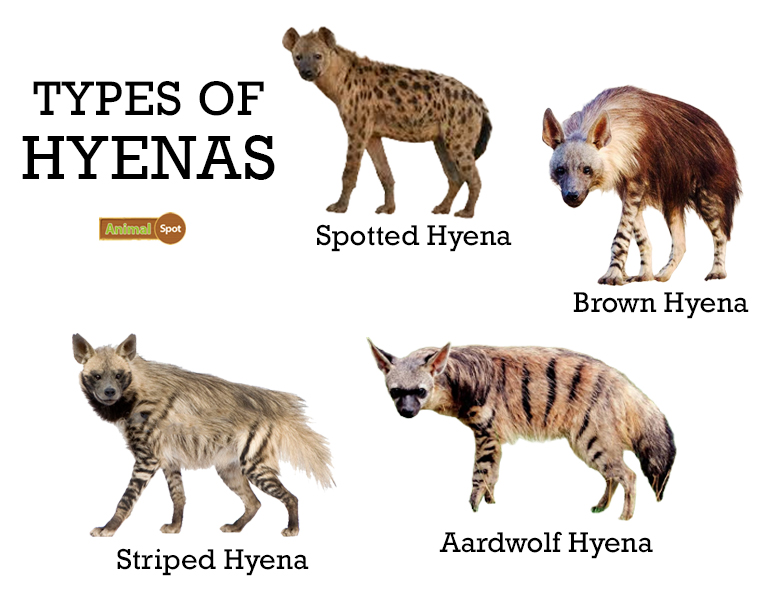


Spotted Hyena (Crocuta crocuta)
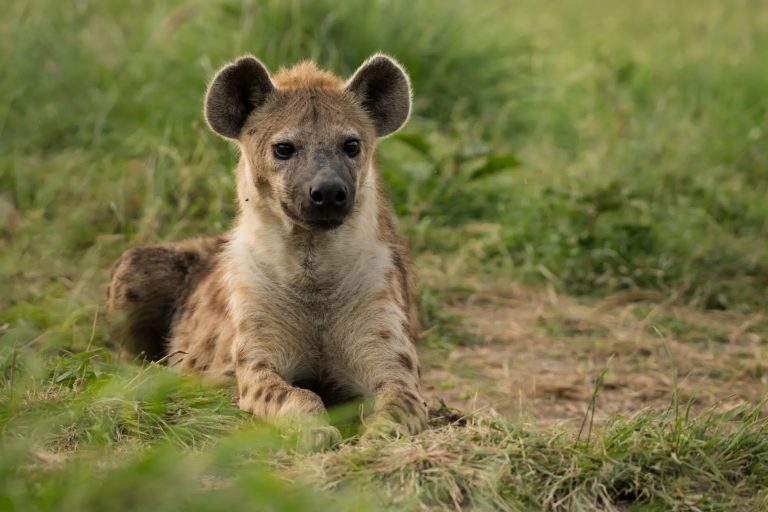
- Larger and more powerfully built
- Rounded ears
- Sloping back with massive forequarters
- Coat covered in dark spots
- Exceptionally strong jaws capable of crushing large bones
Striped Hyena (Hyaena hyaena)
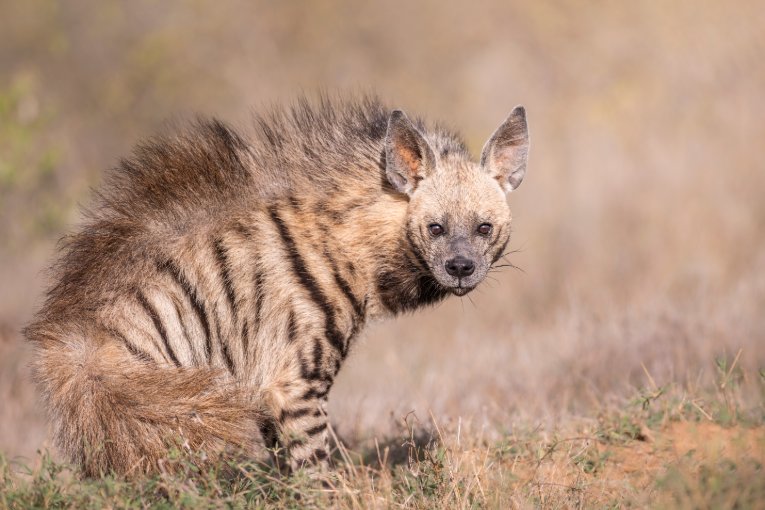
- Smaller, lighter build
- Pointed ears
- Long, erect mane used in threat displays
- Pale grey coat with dark stripes
- Less specialized skull and dentition
In the field, size, posture, and coat pattern are usually sufficient for identification.
3. Social Structure and Intelligence
Spotted Hyena: A Matriarchal Society
Spotted hyenas live in complex clans that can exceed 80 individuals.
- Female-dominated hierarchy
- Rank inherited through maternal lines
- Advanced cooperation and social cognition
- Vocal repertoire rivals that of primates
In ecosystems like the Masai Mara, clans function as political units, competing over territory and carcasses.
Striped Hyena: Solitary and Elusive
Striped hyenas are largely solitary or occur in pairs.
- Minimal social hierarchy
- Weak territorial defense
- Avoid direct competition with larger predators
- Rely on stealth and timing rather than dominance
Their intelligence is expressed through avoidance and adaptability, not social complexity.
4. Hunting, Diet, and Ecological Role
| Aspect | Spotted Hyena | Striped Hyena |
|---|---|---|
| Primary diet | Medium–large ungulates | Carrion, scraps, small animals |
| Hunting | Active endurance hunter | Rare, opportunistic |
| Scavenging | Frequent but competitive | Primary feeding strategy |
| Bone consumption | Extensive | Limited |
| Ecosystem role | Apex or near-apex predator | Cleanup specialist |
A critical misconception is that spotted hyenas are “mostly scavengers.”
In reality, they hunt the majority of their own food, especially in open savannas.
5. Habitat Use and Distribution in Kenya

4
Where Spotted Hyenas Thrive
- Masai Mara National Reserve – Very high densities
- Amboseli National Park
- Tsavo East National Park
- Laikipia Plateau
- Nairobi National Park
Spotted hyenas favor open savannas with abundant prey and tolerate human proximity better than most large carnivores.
Where Striped Hyenas Occur
- Samburu National Reserve
- Buffalo Springs National Reserve
- Shaba National Reserve
- Arid and semi-arid northern Kenya
Striped hyenas avoid dense spotted hyena populations and prefer rocky, dry landscapes.
6. Activity Patterns and Safari Visibility
| Feature | Spotted Hyena | Striped Hyena |
|---|---|---|
| Activity | Day & night | Strictly nocturnal |
| Safari sightings | Very common | Rare |
| Best viewing | Early morning, late afternoon | Night drives only |
Many safari visitors see spotted hyenas daily, while striped hyenas remain a highlight even for seasoned guides.
7. Conservation Status and Threats
Spotted Hyena
- Globally stable but locally persecuted
- Threats: poisoning, road mortality, conflict
- Often killed due to negative perceptions rather than real risk
Striped Hyena
- Near Threatened and declining
- Highly vulnerable to poisoning and habitat loss
- Low reproductive rates and fragmented populations
Striped hyenas require targeted conservation attention, especially outside protected areas.
8. Myths vs Reality
Myth: Hyenas are cowardly scavengers
Reality: Spotted hyenas dominate most African carnivore guilds
Myth: Hyenas are bad for ecosystems
Reality: They reduce disease by rapidly removing carcasses
Myth: All hyenas behave the same
Reality: Spotted and striped hyenas differ fundamentally in ecology and behavior
9. Why the Distinction Matters
Understanding the difference between spotted and striped hyenas matters because:
- Conservation strategies must be species-specific
- Safari education shapes public attitudes
- Misunderstood species are more likely to be persecuted
Spotted hyenas represent power, intelligence, and social complexity.
Striped hyenas represent adaptation, resilience, and ecological cleanup.
Both are indispensable.